Wednesday, August 21, 2013
Canal and Shadow Path
12x9 oil on mdf panel.
From The Spell of the Sensuous by David Abram: "To be sure, by disclosing the body itself as the very subject of awareness, Merleau-Ponty demolishes any hope that philosophy might eventually provide a complete picture of reality (for any such total account of 'what is' requires a mind or consciousness that stands somehow outside of existence, whether to compile the account or, finally, to receive and comprehend it). Yet by this same move he opens, at last, the possibility of a truly authentic phenomenology, a philosophy which would strive, not to explain the world as if from outside, but to give voice to the world from our experienced situation within it, recalling us to our participation in the here-and-now, rejuvenating our sense of wonder at the fathomless things, events and powers that surround us on every hand."
Thursday, August 15, 2013
Flowing Canal
Just when you thought that he can't do any more canal paintings... 9x12 on mdf panel.
You are probably right.
Wednesday, August 14, 2013
Tuesday, August 13, 2013
Sorrento Entr'acte
A couple 9x12 oil paintings of Sorrento; top is Via Bartolomeo Capasso, and bottom is Marina della Lobra, from my visit last year. A change of pace from the canals, though another is on the way.
Thursday, August 8, 2013
Canal Sketching after Monet
The paintings I am working on are not ready, but here are two canal sketches from today's walk. The rectangle is 8x10.
I have been reading the tome From Corot to Monet: The Ecology of Impressionism (an inter-library loan). One essay, "Monet on the Normandy Coast: Ecology and Vision" by Maria Grazia Messina, makes the case for Monet's Etretat and environs paintings reflecting his walking up and down steep paths and selecting uncommon views, in his effort to go beyond the customary depictions of the region done by earlier artists. Monet would carry his gear for miles to paint a view, but he had earlier already made the trek with his sketchbook so he knew where he was going and what he wanted to see.
Wednesday, August 7, 2013
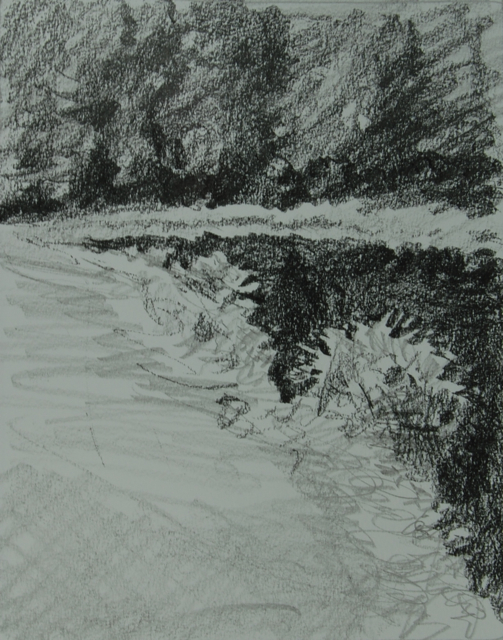
Four Canals
Here are four approaches to the canal: a 9x12 oil on panel, two 9x12 pastel drawings, and an 8x10 graphite drawing.
Ronald Rolheiser writes in The Shattered Lantern, "G.K. Chesterton once commented that our perennial spiritual and psychological task is to learn to look at things familiar until they become unfamiliar again" [his paraphrase from The Everlasting Man, Rolheiser says]. The canal is getting stranger every day!
Labels:
Delaware and Raritan Canal,
drawing,
oil,
pastel
Friday, August 2, 2013
Beholding the Canal Eye
9x12 oil on mdf panel of the canal from the Grant Street bridge.
Brian McLaren writes about "beholding" in Naked Spirituality, "...the winter season beyond Perplexity begins with a kind of nakedness. Naked trees. Frozen ponds. Hibernation. Starkness. Long, dark, silent nights, and cold days blanketed in snow. Autumn exhaustion leads now to winter's rest. That chattering, hypervigilant consciousness--that first judged in Stage One, and then analyzed in Stage Two, and then deconstructed in State Three--now goes silent. It takes a breath. When we open our eyes in this space, we begin to see and know with the meditative mind.
What you look for determines what you see. What you focus on determines what you miss. The way you see determines what you are blind to and what you render invisible. So this meditative kind of seeing accepts the limitations of earlier and noisier ways of seeing, and it practices, in their place, a new vision, a new beholding. When we behold in this new way, we enter a second naivete."
Wednesday, July 31, 2013
Canal Blues
Two more canals. Sorry. I'm in a canal frame of mind. Both 9x12, top oil on mdf panel, bottom pastel on paper.
Labels:
Delaware and Raritan Canal,
drawing,
oil,
pastel
Tuesday, July 30, 2013
Canal with Mystery and Water
Two more canals, top 9x12 oil on mdf panel, and bottom 9x12 pastel drawing.
In his book The Experience of Place, Tony Hiss cites some experts, who studied people's reactions to the natural environment: "Dr. Falk, the grass expert, thinks that we may have inborn responses to several other parts of the natural landscape. 'I'd be amazed if the preference for water in the landscape doesn't prove to be innate,' he told me. 'We've learned that we have to avoid water in any of the pictures we show subjects. It's so highly preferred that its very presence will raise preference by an order of magnitude.'
Drs. Stephen and Rachel Kaplan, a husband-and-wife team of research psychologists at the University of Michigan, think that we may have an inborn preference for winding paths, which provide what they call 'mystery': Landscapes exhibit 'mystery' when they 'give the impression that one could accquire new information if one were to travel deeper into the scene.' According to the Kaplans, who have looked at how people respond to a diversity of environments, 'mystery ... is a factor of great power in predicting preference for scenes of the outdoor environment.'"
Labels:
Delaware and Raritan Canal,
drawing,
oil,
pastel
Monday, July 29, 2013
Far Bridge Canal
Two views of the same location on the canal approaching the far bridge. Top is 9x12 oil on mdf panel, and bottom is 8x10 pastel drawing.
Labels:
Delaware and Raritan Canal,
drawing,
oil,
pastel
Thursday, July 25, 2013
Longview Terrace
A 14x18 oil of a street in Williamstown. Actually it's a canal view from a bridge... OK. It's like a canal view from a bridge.
Wednesday, July 24, 2013
Canal Zone
I am rather focused on the canal these days. I am using this opportunity to determine different ways to paint green, without necessarily painting green. The top drawing is 8x10 pastel, middle 8x10 graphite, and bottom 9x12 pastel.
Tuesday, July 23, 2013
Fast Canal and Nothing Is Only Itself.
A 9x12 pastel drawing.
Below is an excerpt from the poem "Camouflage" by Lawrence Raab.
... Reality, Walker Evans said,
is not totally real ...
... If reality
isn't totally real, how real is it?
In an old anthology of poems, beside a line
about the wind rising over water and the dark
engulfing the trees, somebody's written:
Ah, too true! A sigh: truer than merely true.
Sadder than a fact. And this person
needed to write it down in the margin,
as if to tell me, leafing through
that book as a boy, what I didn't know.
Wind breaks the water's surface.
Evening falls. Nothing is only itself.
"Nothing is only itself." When I encountered that phrase I thought of Matisse painting his still lifes and odalisques, searching for 'true painting'.
Labels:
Delaware and Raritan Canal,
drawing,
Lawrence Raab,
Matisse,
pastel
Monday, July 22, 2013
Three Canals and Matisse's True Painting
Three canals: top 9x12 oil on mdf panel, middle and bottom, 9x12 charcoal and pastel.
I will try to define 'true painting' in a roundabout way. The catalogue treats Matisse's work as a gradual progression. He experiments successfully for the most part during the first 20 years of his career, but he always had doubts. When he did Young Sailor II, an early abstract/realist painting, he "told friends that [it] had been painted by the local postman." I wrote the other day that his still lifes of the mid 1920's first approached 'true painting' with "simulated realism through abstraction," a kind of brilliantly composed, colorfully cartoony decorative depiction of objects. In a section on the first odalisque paintings, which were like the still lifes, except they depicted women, Isabelle Monod-Fontaine writes, "Each canvas of this last series [with two models] shows a checkerboard, which not only signals the matrix at the core of any decorative grid but also serves as a metaphor for the game of painting, which begins over and over again."
In the next section, a further development of odalisques, Jack Flam quotes Matisse: "Underlying this succession of moments which constitutes the superficial existence of beings and things and which is continually modifying and transforming them, one can search for a truer, more essential character, which the artist will seize so that he may give to reality a more lasting interpretation." Here Matisse reaffirms that he was an idealist searching for something eternal, like the icons he admired, and the joy of a lost Eden, seen in his earlier work.
In a later section that focuses on Still Life with Magnolia, a masterpiece that achieves Matisse's idea of 'true painting', Dorthe Aagesen quotes Matisse: "Every time I've done something successfully, I say to myself, 'that's it, I've got it, I understand'; but no, nothing has been learned. The conclusion of the picture is another picture." True painting involves a continual search.
Matisse appears to find 'true painting' in the final series of Vence interiors during the mid- late
1940s. These were done quickly, unlike the paintings of the previous couple decades, for which Matisse wanted to make everyone understand the endless stages of each painting despite their simple-appearing final version. Again, another wonderful quote from Matisse in the section by Cecile Debray: "What I experienced after the operation was a liberation. I told myself that life was gratis from now on. Up until then I had felt overwhelmed by Courbet's saying that 'one always had to be capable of doing a picture over again, to be sure that one was not just being played on by one's nerves and chance.' So I would do my pictures over again to try and find the law that governed my work, and I destroyed them so as to be able to begin again.
It came to me like a ray of sunlight on my house, a kind of liberation.
Before, between my studio and the world outside, there was no complete continuity. Before, I would change the spirit somewhat, there was always a slight gap between nature and what I did: for example, I would look at the sea, and in what I did, the breath one finds in the sea would be missing. Now I no longer understand everything I am doing. I don't know why."
It seems that Matisse found 'true painting' when he stopped looking for it.
A related quote: in the section on Matisse's Moroccan landscapes Cecile Debray writes, "He had come to dread the landscape genre, which he had rarely practiced after his Fauve period, because he found the mutability of nature incompatible with his attempts to simplify and stabilize his compositions."
I find this comment fascinating. Nature can overwhelm the artificiality of painting if you let it.
Labels:
Delaware and Raritan Canal,
drawing,
Matisse,
oil
Subscribe to:
Posts (Atom)