Wednesday, September 18, 2013

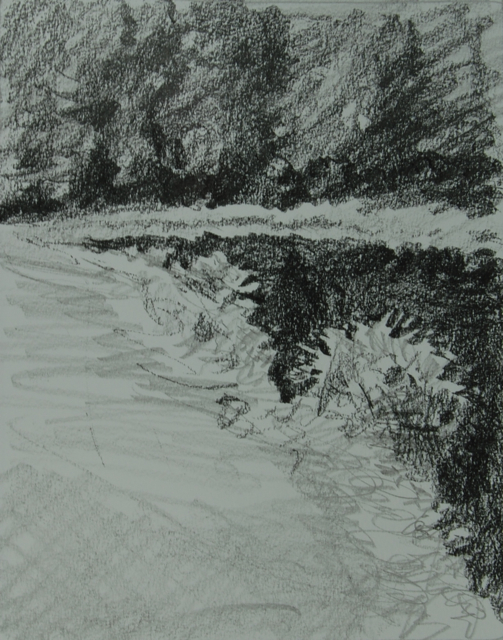
More Shore and Cezanne


A 9x12 pastel and charcoal drawing.

Just completed reading Cezanne and the End of Impressionism by Richard Shiff.  It contains an intriguing line somewhere in the middle: "One is confronted with the possibility that all art is actively made; and impressionism's appearance is not the result of receptive innocence, but active deception."  Deception here means that the artist really does know what he is doing, but paints as if he might not.   Shiff calls this the "technique of originality".  I can't quote the whole book, but Shiff explains why Cezanne is a master impressionist.

Wednesday, September 11, 2013

Back to the Water


Two 8x10 pastels of the Ogunquit coast.

Monday, September 9, 2013

Sweetbrook Farm and Deep Van Gogh


A 14x18 oil painting of the Sweetbrook Farm.

I'm trying to catch up on my reading.  The following is from the March 24, 2010 NY Review of Books (yeah, I know...), a review of Van Gogh's letters by Richard Dorment:  "...when you look at his pictures you sense the depth of experience and the breadth of culture behind them.  Lesser artists like Maurice de Vlaminck or Andre Derain imitated Van Gogh's bright colors, thick paint, and expressive brushwork, but all they achieved in their work was surface excitement.  Their art had none of the moral weight and psychological density that in Van Gogh's came from living among the poor, taking the gospels to heart, poring over the works of Shakespeare and many other writers, and studying the history of art."

Sunday, September 8, 2013

The Poignancy of Impermanence


9x12 pastel and charcoal drawing.

A friend told me this morning, after he examined my pictures on line, that he coined the phrase "the poignancy of impermanence" to describe his experience.   He told me that in his former life he drove a cab in Brooklyn, and when stopped, saw and now remembers the things that I paint.  Very gratifying.

Impermanence is the area within which I work.

And later this morning a neighbor, who looks at my blog frequently, told me that she has become re-inspired to visit Maine.


Friday, September 6, 2013

Sea Outlet


A 9x12 oil of the inlet at Ogunquit.

Thursday, September 5, 2013

Encompassing Earth


A 9x12 pastel and charcoal drawing with a quote from David Abram's great book, The Spell of the Sensuous:

"It would seem...that the conceptual separation of time and space--the literate distinction between a linear, progressive time and a homogeneous, featureless space--functions to eclipse the enveloping earth from human awareness.  As long as we structure our lives according to assumed parameters of a static space and a rectilinear time, we will be able to ignore, or overlook, our thorough dependence upon the earth around us.  Only when space and time are reconciled into a single, unified field of phenomena does the encompassing earth become evident, once again, in all its power and its depth, as the very ground and horizon of all our knowing."

Wednesday, September 4, 2013

Coast Line


This time a 9x12 oil of the coast line.  The water moves one way, the coast another, and the rocks don't move at all.

Tuesday, September 3, 2013

Sea Coast


Today I am starting a new series of sea coasts, actually mainly one varied sea coast, in Ogunquit, Maine.  I need to give the canals a rest.  The above is a 9x12 pastel drawing.

Wednesday, August 21, 2013

Canal and Shadow Path


12x9 oil on mdf panel.

From The Spell of the Sensuous by David Abram:  "To be sure, by disclosing the body itself as the very subject of awareness, Merleau-Ponty demolishes any hope that philosophy might eventually provide a complete picture of reality (for any such total account of 'what is' requires a mind or consciousness that stands somehow outside of existence, whether to compile the account or, finally, to receive and comprehend it).  Yet by this same move he opens, at last, the possibility of a truly authentic phenomenology, a philosophy which would strive, not to explain the world as if from outside, but to give voice to the world from our experienced situation within it, recalling us to our participation in the here-and-now, rejuvenating our sense of wonder at the fathomless things, events and powers that surround us on every hand."

Thursday, August 15, 2013

Flowing Canal


Just when you thought that he can't do any more canal paintings... 9x12 on mdf panel.
You are probably right.

Wednesday, August 14, 2013

Canal Slice


9x12 oil on mdf panel of the canal.

Tuesday, August 13, 2013

Sorrento Entr'acte


A couple 9x12 oil paintings of Sorrento; top is Via Bartolomeo Capasso, and bottom is Marina della Lobra, from my visit last year.  A change of pace from the canals, though another is on the way.

Thursday, August 8, 2013

Canal Sketching after Monet


The paintings I am working on are not ready, but here are two canal sketches from today's walk.   The rectangle is 8x10.

I have been reading the tome From Corot to Monet: The Ecology of Impressionism (an inter-library loan).  One essay, "Monet on the Normandy Coast: Ecology and Vision" by Maria Grazia Messina, makes the case for Monet's Etretat and environs paintings reflecting his walking up and down steep paths and selecting uncommon views, in his effort to go beyond the customary depictions of the region done by earlier artists.  Monet would carry his gear for miles to paint a view, but he had earlier already made the trek with his sketchbook so he knew where he was going and what he wanted to see.

Wednesday, August 7, 2013

Four Canals


Here are four approaches to the canal: a 9x12 oil on panel, two 9x12 pastel drawings, and an 8x10 graphite drawing.  

Ronald Rolheiser writes in The Shattered Lantern, "G.K. Chesterton once commented that our perennial spiritual and psychological task is to learn to look at things familiar until they become unfamiliar again" [his paraphrase from The Everlasting Man, Rolheiser says].  The canal is getting stranger every day!


Friday, August 2, 2013

Beholding the Canal Eye


9x12 oil on mdf panel of the canal from the Grant Street bridge.

Brian McLaren writes about "beholding" in Naked Spirituality, "...the winter season beyond Perplexity begins with a kind of nakedness.  Naked trees. Frozen ponds.  Hibernation.  Starkness.  Long, dark, silent nights, and cold days blanketed in snow.  Autumn exhaustion leads now to winter's rest.  That chattering, hypervigilant consciousness--that first judged in Stage One, and then analyzed in Stage Two, and then deconstructed in State Three--now goes silent.  It takes a breath.  When we open our eyes in this space, we begin to see and know with the meditative mind.

What you look for determines what you see.  What you focus on determines what you miss.  The way you see determines what you are blind to and what you render invisible.  So this meditative kind of seeing accepts the limitations of earlier and noisier ways of seeing, and it practices, in their place, a new vision, a new beholding.  When we behold in this new way, we enter a second naivete."